A History of Central Banking and the Enslavement of Mankind by Stephen Goodson
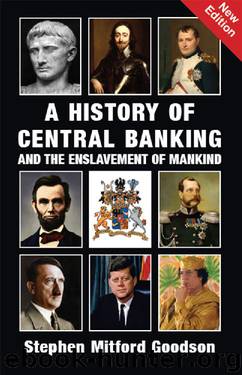
Author:Stephen Goodson [Goodson, Stephen]
Language: eng
Format: epub, pdf
Publisher: Black House Publishing Ltd
Published: 2018-07-01T21:00:00+00:00
Full financial control must be returned to the Ministry of Finance. (Then forced to pay for anything the army desired.)
Price and wage control must be rendered effective. The existing mismanagement must be eliminated.
The use of money and investment markets must be at the sole discretion of the Reichsbank. (This meant a practical elimination of Göring’s Four Year Plan).”[251]
Schacht concluded his memorandum with the ambiguous words: “We shall be happy to do our best to collaborate with all future goals, but for now the time has come to call a halt.”[252] By these means Schacht intended to collapse the German economy,[253] which during the period 1933-39 had increased its Gross National Product by 100 percent. From being a ruined and bankrupt nation in January 1933 with 7,500,000 unemployed persons,[254] Hitler had transformed Germany into a modern socialist paradise. He was justifiably angry and rejected the recommendations of the Reichsbank as “mutiny”.[255] Two weeks later Schacht was sacked. Roger Elletson describes this momentous event as follows: “On 19 January 1939, Schacht was summarily dismissed, and the Reichsbank was ordered to grant the Reich all credits requested by Hitler. This decisive action essentially emasculated both the Reichsbank’s control over domestic monetary policy, and the German power base of international Jewry. It had the effect of removing from Jewish bankers the power to deflate and destroy the German economy.
Excluding the implications of the interest rate paid on the MEFO bills, Germany could now be viewed as being on a “Feder System”, rather than a “Schacht System”. The Reichsbank effectively became an arm of the government, with the only real change being in the fact that bills were now monetised, or discounted, under the auspices of the State rather than some Jewish lackey in the Reichsbank presidency.”[256] Thus only in January 1939 did the Reichsbank become an authentic State Bank. Schacht’s dismissal also terminated the transfer of confidential information regarding all Germany’s economic developments,[257] which he had been deviously giving without interruption to Montagu Norman,[258] a fellow mason and Governor of the Bank of England (1920-44).
A new Reichsbank law, which was promulgated on 15 June 1939, made the bank “unconditionally subordinated to the sovereignty of the state.”[259]
Article 3 of the law decreed that the bank, renamed the Deutsche Reichsbank, should be “directed and managed according to the instructions and under the supervision of the Führer and Reichschancellor.”[260]
Hitler was now his own banker, but having departed from the fold of international swindlers and usurers he would, like Napoléon Bonaparte, who in 1800 had established the Banque de France as a state bank, suffer the same fate; an unnecessary war followed by the ruination of his people and country. It was this event which triggered World War II – the realisation by the Rothschilds that universal replication of Germany’s usury-free state banking system would permanently destroy their evil financial empire. In order to provide the Poles with a free hand, which would enable them to antagonise and provoke the Germans, a deceitful and worthless offer to guarantee[261] Poland’s sovereignty was given by Great Britain on 31 March 1939.
Download
A History of Central Banking and the Enslavement of Mankind by Stephen Goodson.pdf
This site does not store any files on its server. We only index and link to content provided by other sites. Please contact the content providers to delete copyright contents if any and email us, we'll remove relevant links or contents immediately.
International Integration of the Brazilian Economy by Elias C. Grivoyannis(111064)
The Radium Girls by Kate Moore(12033)
Turbulence by E. J. Noyes(8055)
Nudge - Improving Decisions about Health, Wealth, and Happiness by Thaler Sunstein(7711)
The Black Swan by Nassim Nicholas Taleb(7134)
Rich Dad Poor Dad by Robert T. Kiyosaki(6642)
Pioneering Portfolio Management by David F. Swensen(6303)
Man-made Catastrophes and Risk Information Concealment by Dmitry Chernov & Didier Sornette(6022)
Zero to One by Peter Thiel(5805)
Secrecy World by Jake Bernstein(4755)
Millionaire: The Philanderer, Gambler, and Duelist Who Invented Modern Finance by Janet Gleeson(4481)
The Age of Surveillance Capitalism by Shoshana Zuboff(4301)
Skin in the Game by Nassim Nicholas Taleb(4252)
The Money Culture by Michael Lewis(4211)
Bullshit Jobs by David Graeber(4195)
Skin in the Game: Hidden Asymmetries in Daily Life by Nassim Nicholas Taleb(4009)
The Dhandho Investor by Mohnish Pabrai(3770)
The Wisdom of Finance by Mihir Desai(3751)
Blockchain Basics by Daniel Drescher(3585)
